
Why Website Visitors Don't Become Leads
Most small business websites convert between 1% and 2% of visitors into enquiries. The best-performing ones convert 5% to 8%. That gap isn't a traffic problem — it's a conversion problem. Here's where it usually breaks.
Most small-business websites convert between 1% and 2% of visitors into enquiries. The best-performing ones convert 5% to 8%. That gap isn't a traffic problem — it's a conversion problem. The difference between an average website and an exceptional one usually comes down to the same handful of friction points repeated across the funnel.
The visitor journey is rarely as linear as we assume
We tend to imagine visitors arriving on the homepage, reading the about page, browsing services, and then enquiring. In reality, most visitors arrive on a deeper page from a Google search, skim it for fifteen seconds, glance at one or two other pages, and either enquire or leave. The implication is uncomfortable: every page is a potential entry point, and every page therefore needs to do conversion work on its own.
They don't know what to do next
The single most common reason visitors don't convert is that they aren't sure what they're supposed to do. Some pages have three competing calls-to-action. Others have none at all. Most have a button that says "Contact us" — which is the conversion equivalent of "Have a think about it." A clear, specific, prominent next step on every page is the conversion lever most websites haven't pulled.
The site doesn't speak their language
Many small-business websites read like they were written for industry peers rather than customers. They use jargon, technical specifications, and abstract benefit statements. Visitors don't recognise themselves in the copy. They want to know: do you work with businesses like mine, do you understand my problem, and can you fix it? If the answer to any of those isn't obvious within ten seconds, they leave.
Trust signals are missing or out of place
Trust isn't a single thing — it's a stack of micro-signals that accumulate as the visitor scrolls. The logo of a recognisable client. A specific testimonial with a name and outcome. A photograph of the actual team. A clear address. A response time guarantee. A privacy policy. Each one is small, but in aggregate they make the difference between a visitor enquiring and quietly closing the tab to "think about it" (a euphemism for "never again").
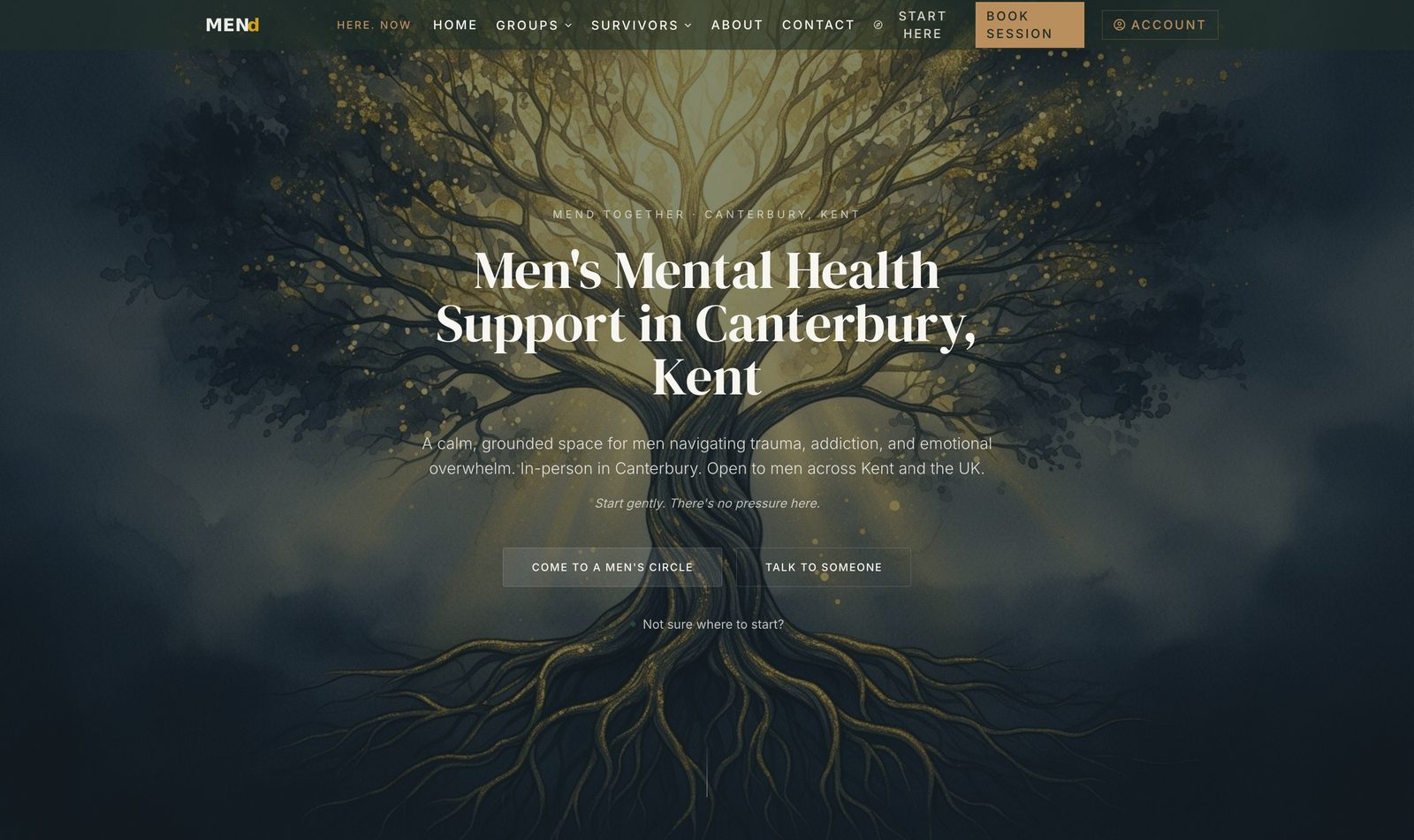
A men's mental-health platform that quietly reaches the men who need it most.
MENd Together is a CIC supporting men with trauma and emotional recovery. We rebuilt the digital surface from the ground up so the right men could find it on Google, trust it on first visit, and reach out without friction.
Read the case studyFree Business Growth Report
Discover how visible your business really is.
A personalised report on your local demand, visibility opportunities, growth barriers and revenue potential — built specifically for your business.
- Local demand
- Visibility opportunities
- Growth barriers
- Revenue potential
- Recommended next steps
Mobile experience quietly kills conversions
The mobile experience on most small-business websites lags significantly behind the desktop experience — and yet mobile is now usually 55% to 75% of traffic. Slow load times, tap targets that are too small, forms that don't fit the screen, menus that require precision finger work: each of these halves your conversion rate without anyone noticing. The fix is rarely a redesign; it's a serious mobile audit and a willingness to act on what it shows.
Forms are the highest-friction moment in the funnel
By the time a visitor reaches the contact form, they've already done the hard work of deciding they're interested. The form's job is simply not to lose them. Every additional field — and especially every additional required field — costs conversions. The data is consistent across industries: shorter forms convert better. If you don't strictly need a phone number, a postcode, or a company size to start the conversation, don't ask for them.
Speed is the silent disqualifier
A site that takes six seconds to load on mobile loses roughly half its visitors before they see anything. They aren't deciding to leave — they're being asked to wait, and they're choosing not to. Modern visitors have effectively zero patience for slow sites. Compress images, defer non-essential scripts, and accept that no animation is worth two seconds of perceived load time.
The fix isn't more traffic — it's better conversion
When enquiries are low, the instinct is to drive more traffic. But doubling traffic on a 1% site gets you twice as many enquiries; doubling the conversion rate gets you the same result at no extra cost. The businesses that quietly outperform their competitors are the ones who fix the leaks before they pour in more water.
For the structural reasons behind most of these friction points, our pillar article on why most business websites don't generate enquiries walks through the underlying causes in detail.
Free Business Growth Report
Discover how visible your business really is.
A personalised report on your local demand, visibility opportunities, growth barriers and revenue potential — built specifically for your business.
- Local demand
- Visibility opportunities
- Growth barriers
- Revenue potential
- Recommended next steps
Read next · Websites
Keep reading


Related services