
How To Improve Website Conversion Rates
Conversion rate is the single highest-leverage number in a small business's marketing. Doubling it doubles your effective revenue without spending another penny on traffic. Here's the framework we use to do exactly that.
Conversion rate is the single highest-leverage number in a small business's marketing. Doubling it doubles your effective revenue without spending another penny on traffic. And yet most businesses optimise for traffic almost exclusively, while the conversion rate quietly sits at 1.2% for years. Here's how to change that.
Why conversion rate is a leverage point
A site converting 1.5% of 2,000 monthly visitors produces 30 enquiries a month. Improve the conversion rate to 3% — entirely realistic for most small businesses — and the same traffic produces 60 enquiries. No additional ad spend. No additional SEO work. Just better persuasion, applied consistently. Compounded over a year, that's hundreds of additional opportunities.
Diagnose before you optimise
The first instinct most owners have is to start changing things. Don't. Spend two weeks watching what visitors actually do. Heatmaps, session recordings, funnel reports, form analytics, search console data. Identify where the drop-offs are biggest. The page you think is broken often isn't. The page you've never thought about often is.
The hierarchy of conversion improvements
Some changes move the needle 20%. Others move it 1%. Working through them in the right order saves enormous time and energy.
- The headline — what the visitor reads first
- The primary call-to-action — what they're asked to do
- The trust stack — testimonials, logos, proof
- The form — friction at the moment of decision
- The mobile experience — usually 60%+ of traffic
The headline does most of the work
A bad headline kills good traffic. A good headline rescues mediocre traffic. The headline should answer "what do you do, who for, and where" in one tight, clear sentence — and it should hint at the outcome the visitor cares about. Don't be clever; be specific. The most-converting headlines tend to be the plainest.
The primary CTA matters more than the design
The button that does the most work on your site deserves the most thinking. The label should be specific ("Get my free growth report"), the placement should be visible without scrolling, and the colour should contrast clearly with the rest of the page. A single, well-designed primary CTA usually outperforms three competing ones.
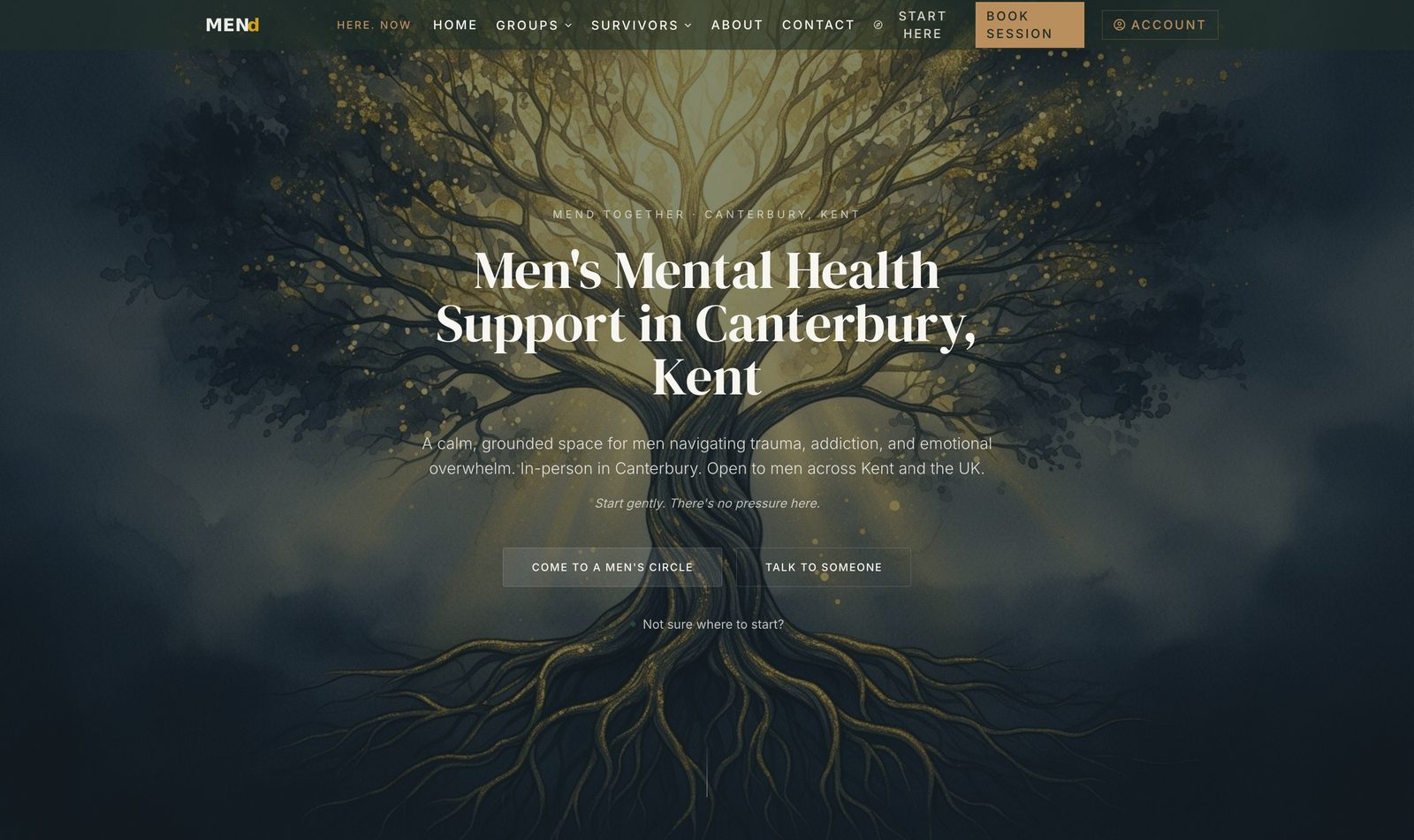
A men's mental-health platform that quietly reaches the men who need it most.
MENd Together is a CIC supporting men with trauma and emotional recovery. We rebuilt the digital surface from the ground up so the right men could find it on Google, trust it on first visit, and reach out without friction.
Read the case studyFree Business Growth Report
Discover how visible your business really is.
A personalised report on your local demand, visibility opportunities, growth barriers and revenue potential — built specifically for your business.
- Local demand
- Visibility opportunities
- Growth barriers
- Revenue potential
- Recommended next steps
Reduce friction at every step
Every required form field reduces conversion. Every additional click reduces conversion. Every extra second of load time reduces conversion. The art of optimisation is the art of subtraction. What can be cut? What can be made faster, shorter, simpler, more obvious? The best-performing sites feel almost insultingly easy to use.
A/B testing for small businesses
You don't need enterprise tooling. Most small businesses can run sequential tests — change one thing, measure for two weeks, compare to baseline. Even informal testing beats no testing. The discipline is to change one variable at a time and write down what you expect to happen before you measure it.
The metrics worth tracking
Don't drown in data. The handful that matter for most small businesses: total monthly enquiries, conversion rate by page, mobile vs desktop conversion, time-to-first-response (a service metric, but it affects repeat business), and source-of-enquiry. Review monthly. Improve one thing. Repeat.
Compounding small wins
A 1.2% conversion rate becomes 1.5% becomes 1.9% becomes 2.5% over twelve months of consistent attention. None of the individual changes are dramatic. The cumulative effect almost always is. Most of the businesses we audit could double their conversion rate within a year by addressing items they already half-know are issues.
For the underlying structural causes that keep most websites stuck below 2%, see our pillar article on why most business websites don't generate enquiries.
Free Business Growth Report
Discover how visible your business really is.
A personalised report on your local demand, visibility opportunities, growth barriers and revenue potential — built specifically for your business.
- Local demand
- Visibility opportunities
- Growth barriers
- Revenue potential
- Recommended next steps
Read next · Websites
Keep reading


Related services