
When Should A Business Build An App?
Too early and the cost outweighs the benefit. Too late and the business is constrained by its systems. The right moment is identifiable — and it's almost always six months earlier than owners realise.
Too early and the cost outweighs the benefit. Too late and the business is constrained by its systems. The right moment is identifiable — and it's almost always six months earlier than owners realise.
Three quantitative signals
Customer base over 100 active. Team over 4 people. Repeat-task time per team member over 5 hours/week. When all three are true, the maths usually justifies a custom system. When two are true, it's worth modelling. When one is true, it's probably too early.
Three qualitative signals
"We can't do X for our customers because the system can't handle it." "Onboarding new team members takes weeks because everything is in someone's head." "We're afraid of growth because the operations would break." When you hear these phrases regularly, the time has arrived.
The opportunity-cost trap
Owners often delay because the upfront cost feels high. But the cost of NOT building — measured in hours wasted, customers lost, errors made, growth deferred — is usually larger and silently growing every quarter. The honest question isn't "can we afford this?" but "what is staying the same actually costing us?"
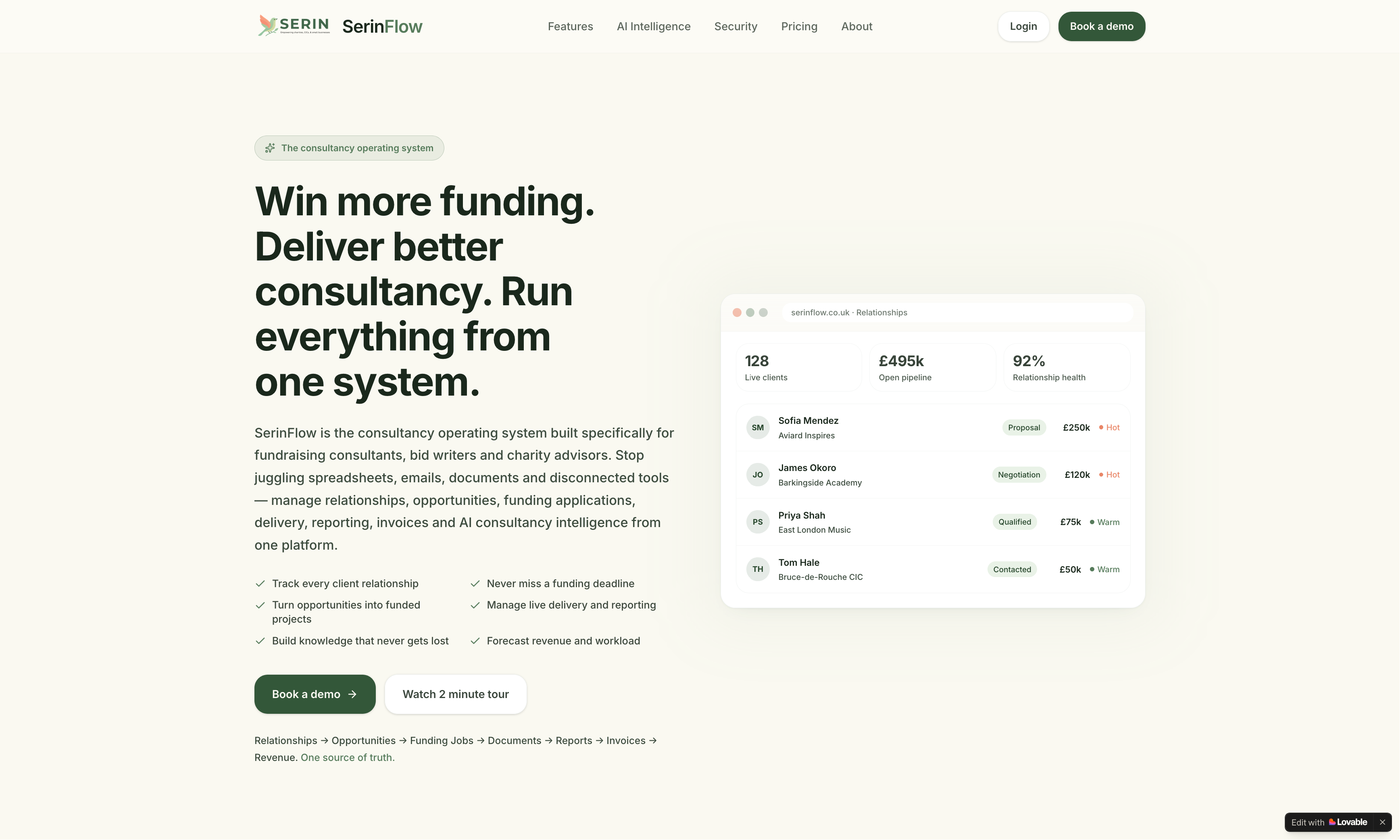
The operating system fundraising consultants didn't know they were allowed to want.
SerinFlow is a custom-built consultancy platform for fundraising consultants, bid writers and charity advisors. One place to manage relationships, opportunities, applications, delivery, reporting, invoices and AI consultancy intelligence — instead of seven disconnected tools.
Read the case studyFree Business Growth Report
Discover how visible your business really is.
A personalised report on your local demand, visibility opportunities, growth barriers and revenue potential — built specifically for your business.
- Local demand
- Visibility opportunities
- Growth barriers
- Revenue potential
- Recommended next steps
Why "wait until we're bigger" usually fails
A business that can't operate efficiently at its current size won't magically operate efficiently at twice its current size. Worse: scaling on broken systems usually breaks the business or burns out the team before it gets to the larger size at all. The system upgrade has to come first or simultaneously.
Why building too early hurts
Building before you understand your own workflow well enough means building the wrong thing. The earliest builds are also the most likely to require expensive rebuilds within 18 months. If you're not sure what your operational pain points really are, run lean for another 6 months while explicitly observing — then build with clarity.
The middle path
Most small businesses should build their first internal app between year 2 and year 4 of operations. Earlier than that, you don't yet know what to build. Later than that, you're losing real money daily. Within that window, the right time is "as soon as you can name three workflows that are clearly broken and would survive a system upgrade unchanged in shape."
For the deeper question, see does your business actually need an app?
Free Business Growth Report
Discover how visible your business really is.
A personalised report on your local demand, visibility opportunities, growth barriers and revenue potential — built specifically for your business.
- Local demand
- Visibility opportunities
- Growth barriers
- Revenue potential
- Recommended next steps
Read next · Web & Mobile Apps
Keep reading


Related services