
How Custom Apps Save Businesses Time And Money
The maths of a well-built custom app is surprisingly compelling. Five hours saved per week per team member. Errors eliminated. Customers self-serving. Twelve months in, the system has usually paid for itself twice over.
The maths of a well-built custom app is surprisingly compelling. Five hours saved per week per team member. Errors eliminated. Customers self-serving where they used to email. Twelve months in, the system has usually paid for itself twice over — and the savings keep compounding for years.
Time is the most under-priced asset in small business
A small team of five people, each spending 5 hours a week on tasks that should be automated, loses 25 hours weekly. Annualised, that's 1,300 hours — roughly 0.6 of a full-time hire — being burned on work that adds zero value. Most owners notice the salary cost of a new hire long before they notice the time cost of bad systems.
What custom apps automate well
Repetitive admin (invoicing, scheduling, reminders), data entry across disconnected tools, customer status updates, internal handoffs between team members, reporting and dashboards, customer self-service. These are the unglamorous wins that quietly save the most hours.
The error-cost most owners ignore
A spreadsheet-based business will misquote, misschedule, or miscommunicate maybe 2-5% of the time. Each error has a real cost — refunds, redo work, reputation damage, frustrated customers. A well-designed app reduces that to near zero. The avoided cost of errors often exceeds the labour savings.
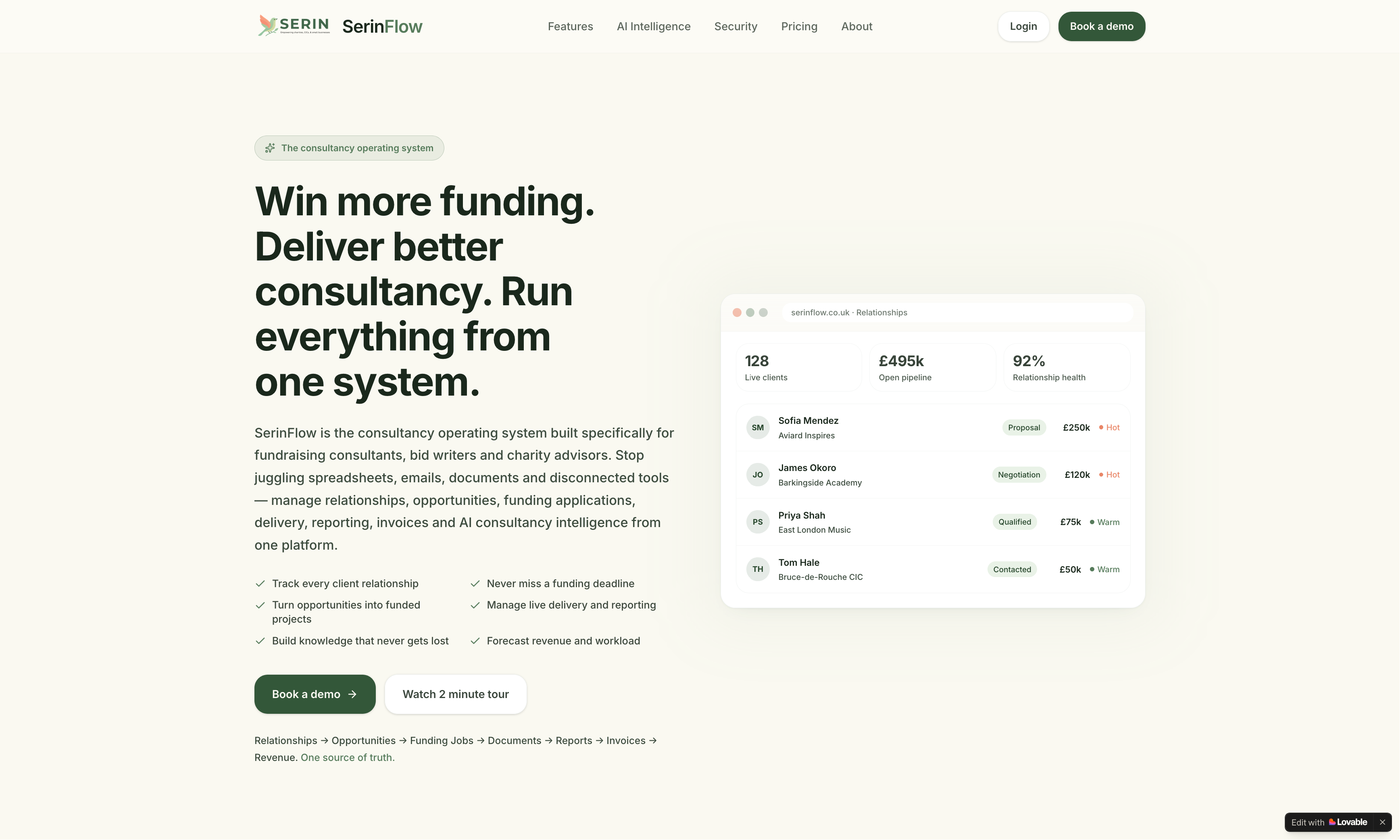
The operating system fundraising consultants didn't know they were allowed to want.
SerinFlow is a custom-built consultancy platform for fundraising consultants, bid writers and charity advisors. One place to manage relationships, opportunities, applications, delivery, reporting, invoices and AI consultancy intelligence — instead of seven disconnected tools.
Read the case studyFree Business Growth Report
Discover how visible your business really is.
A personalised report on your local demand, visibility opportunities, growth barriers and revenue potential — built specifically for your business.
- Local demand
- Visibility opportunities
- Growth barriers
- Revenue potential
- Recommended next steps
Customer self-service is a margin lever
Every email a customer sends asking "where's my order" or "what time is my appointment" or "can I reschedule" is a small unit of labour cost. A customer portal that answers those questions instantly — and lets the customer self-serve — converts those touchpoints into zero-cost interactions. For a business with 200+ active customers, the saving is enormous.
The realistic ROI timeline
Month 1-3: app being built; no savings yet. Month 4-6: launch + adoption; modest savings. Month 7-12: full adoption; clear weekly time savings. Month 13-24: compound effect kicks in — team capacity freed up for higher-value work, customer satisfaction improves, churn drops. Month 25+: app is essentially free; pure ongoing margin.
What kills the ROI
Building too much before testing what's actually used (over-spec). Skipping training (low adoption). Treating it as a one-off project rather than a living system (it stagnates). The businesses that get the maths to work treat the app as a piece of infrastructure that's improved every quarter for the next five years.
The decision question
Don't ask "can we afford an app?" — ask "what does the time we're currently wasting cost us per year, and how does that compare to the cost of building a system that recovers it?" The answer almost always justifies the investment. For the strategic backdrop, see does your business actually need an app?
Free Business Growth Report
Discover how visible your business really is.
A personalised report on your local demand, visibility opportunities, growth barriers and revenue potential — built specifically for your business.
- Local demand
- Visibility opportunities
- Growth barriers
- Revenue potential
- Recommended next steps
Read next · Web & Mobile Apps
Keep reading


Related services